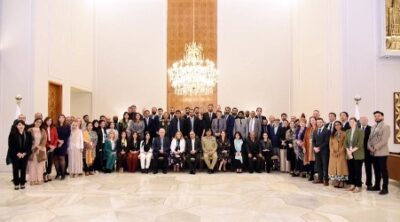

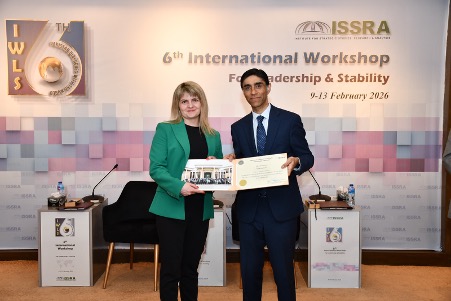
On February 9–13, 2026, Associate Professor of the Department Inna Koblianska took part in the International Workshop on Leadership and Stability held at the Institute for Strategic Studies, Research and Analysis of the National Defence University in Islamabad.
The workshop brought together 100 participants from over 50 countries. Participants discussed current challenges to global security, the transformation of the world order, and regional dynamics. Considerable attention was paid to issues of economic development, in particular opportunities for trade, investment, and entrepreneurship in Pakistan, as well as the role of economic factors in ensuring stability. Separate sessions addressed the formation of public narratives in the era of digital transformations, future global trends, and the importance of culture, art, and historical heritage for strengthening national identity and international dialogue. Participants also worked in small groups on analytical tasks related to global and regional processes and presented the results of their joint work during panel discussions. Inna Koblianska presented the results of her research conducted within the framework of the research project “Fundamentals of Sustainable and Inclusive Regional Spatial Development for Post-War Reconstruction in the Context of Digital Transformation” (state registration No. 0125U001620, 2025–2027), funded by the State Budget of Ukraine.
A special highlight of the workshop was a meeting with the President of the Islamic Republic of Pakistan, during which delegates had the opportunity to ask questions on regional security, international cooperation, and the role of leadership in the modern world.
The programme also included meetings with representatives of government institutions and the expert community, including a talk by the Finance Minister of Pakistan, as well as visits to key institutions and landmarks of the country. Delegates visited the Ministry of Foreign Affairs of Pakistan, Parliament House, the National Aerospace Science and Technology Park (NASTP), and major cultural sites, including Faisal Mosque, the Pakistan Monument, the Lok Virsa Museum, the Pakistan National Council of the Arts, and the Islamabad Museum. These meetings and visits provided a deeper understanding of the country’s political system, cultural features, and scientific and technological potential.
Participation in the international workshop contributed to expanding professional contacts, exchanging experience in leadership, strategic analysis, and stability, and strengthening the Department’s international academic cooperation.
As a result of the workshop, participants received certificates and outlined possible areas for further joint research and educational initiatives.