
The Department of Economics, Entrepreneurship, and Business Administration continues to implement the training course “EU Practices of Research Excellence in the Digital Era,” aimed at developing modern research competencies in line with the best European practices. The course is delivered within the framework of the Jean Monnet Chair “Strengthening EU Leadership and Capacity in Science and Innovation” (101175767—EU_STRENGHTS—ERASMUS-JMO-2024-HEI-TCH-RSCH) 2024–2027, funded by the European Union. The course started on January 5 and will run until January 30, 2026. A total of 150 participants from different educational institutions and regions of Ukraine are enrolled in the program.
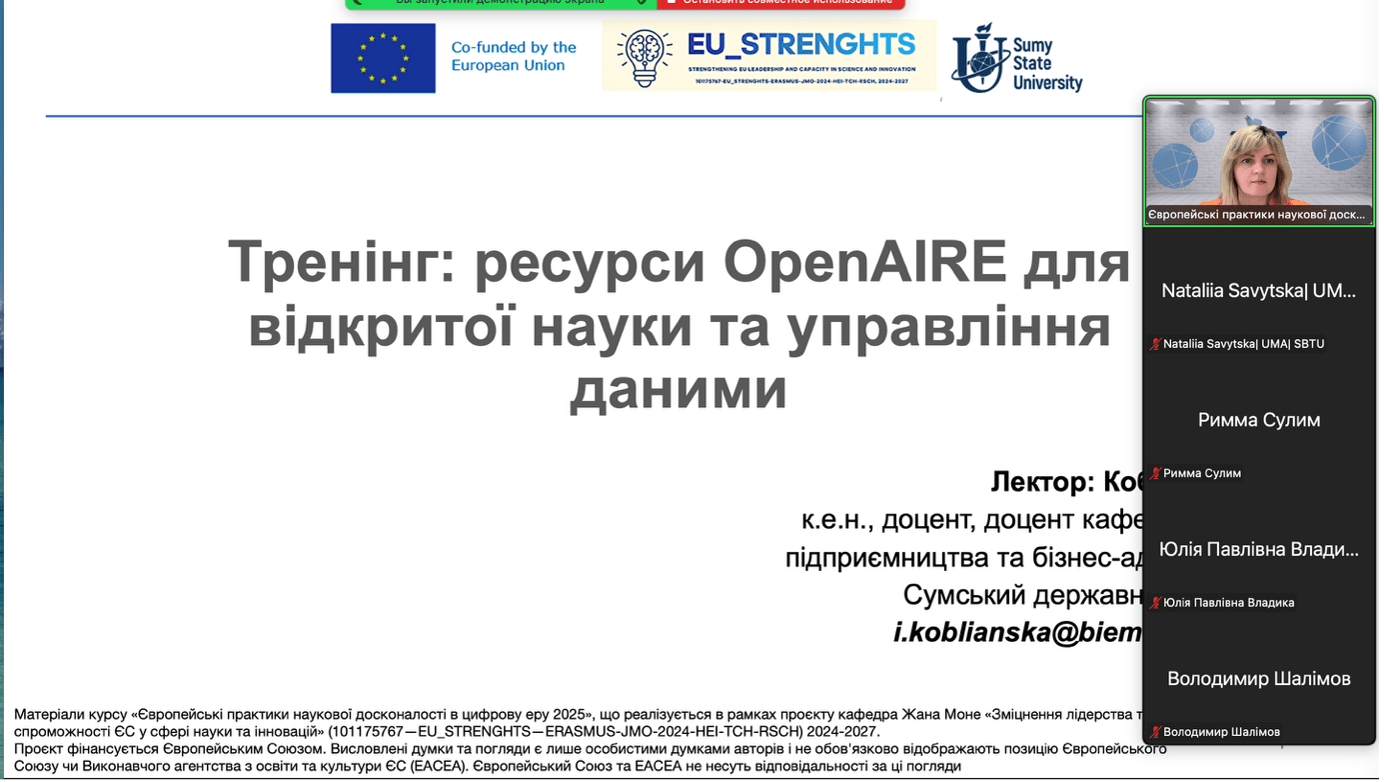
During the first three days of training, participants became acquainted with approaches to organising scientific research in the European Union. Particular attention was paid to the concept of open science, the principles of FAIR data management, issues of research ethics, confidentiality, and the responsible use of research results. The classes were conducted by Associate Professor Inna Koblianska, PhD (Economics), as well as Vasyl Kvartiuk, researcher at IAMO, who presented the specifics of organising research activities in European scientific institutions.
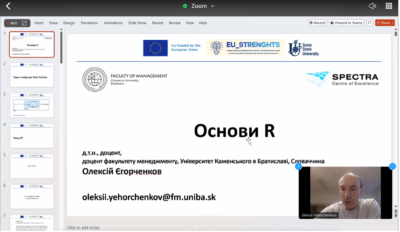
The subsequent sessions were of a more applied nature and focused on working with research data and its analytical processing. Under the guidance of Oleksii Yehorchenkov, Associate Professor at Comenius University in Bratislava, participants made their first practical steps in using the R programming environment, mastering basic tools for data visualisation and interpretation.
The learning process takes place in an interactive format, involving active discussions, the analysis of practical case studies, and participants’ engagement in solving research tasks. In the following stages, the course will cover a broader range of tools and methodologies, contributing to the improvement of research quality and further integration into the European research area.
Jean Monnet Chair «Strengthening EU Leadership and Capacity in Science and Innovation» (101175767—EU_STRENGHTS—ERASMUS-JMO-2024-HEI-TCH-RSCH) 2024-2027. Funded by the European Union. Views and opinions expressed are however those of the author(s) only and do not necessarily reflect those of the European Union or the European Education and Culture Executive Agency (EACEA). Neither the European Union nor EACEA can be held responsible for them.