
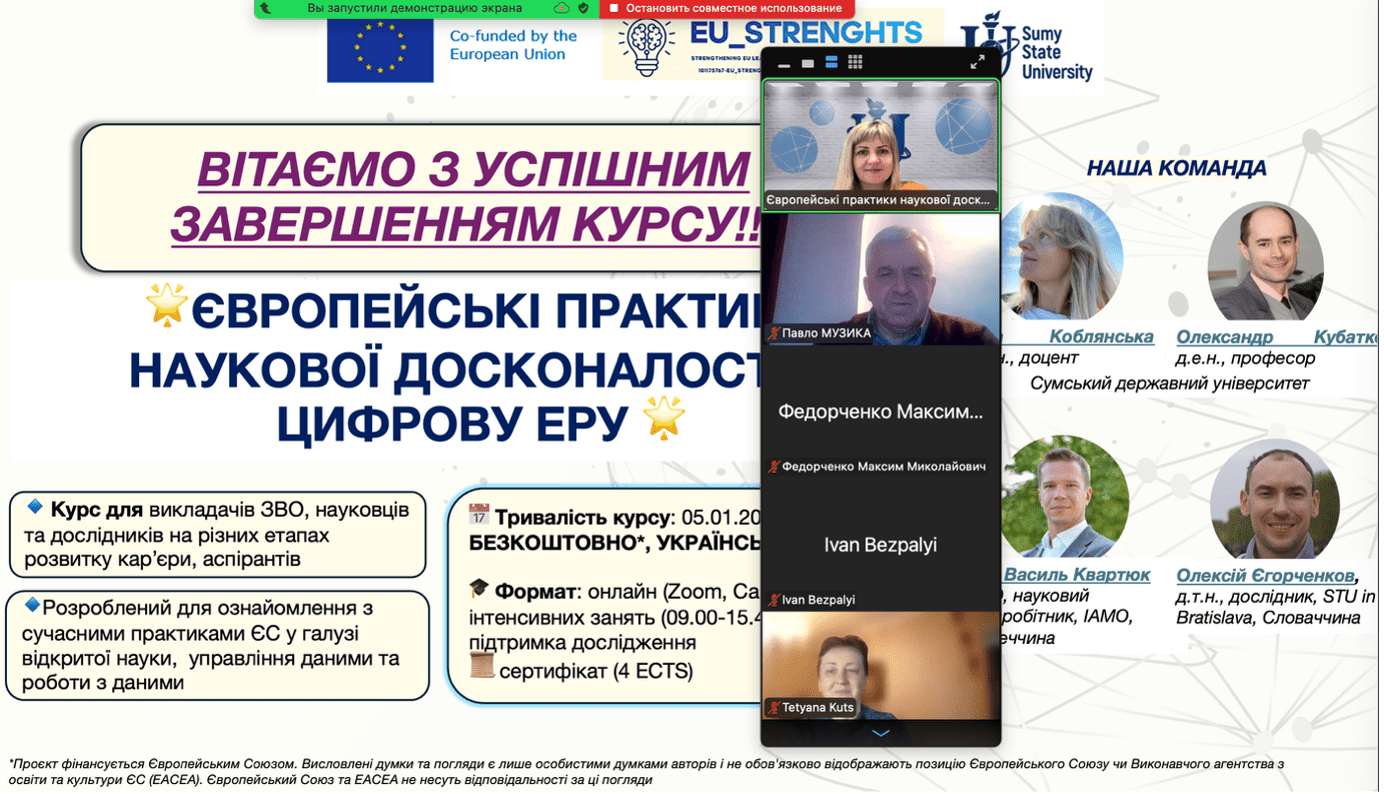
The course “European Practices of Research Excellence in the Digital Era” has been completed at Sumy State University. The course was aimed at familiarising lecturers and researchers with contemporary European Union approaches to open science, research data management, and ensuring the quality of scientific research.
From 5–30 January 2026, participants worked in an intensive online format, combining lectures, practical sessions, analytical work, and mentorship support. The course served as a platform for professional exchange of experience, academic discussions, and the establishment of new scholarly contacts. As a result of the training, 154 participants received certificates (4 ECTS).
The programme covered the following areas:
– open science and FAIR data management
– ethics and confidentiality of research data
– preparation of research projects in line with EU practices
– data work, analysis in R and STATA, and visualisation
– academic writing, publishing practices, and the use of Zotero
– EU resources for research communication and funding.
The course was delivered by representatives of Sumy State University and international experts: Inna Koblianska, Oleksandr Kubatko, Dr Vasyl Kvartiuk (IAMO, Germany), and Oleksii Yehorchenkov (Comenius University, Slovakia).
The organisers express their gratitude to the participants for their active engagement, professional interest, and readiness to implement European research approaches in their own academic activities.
Further development of scientific cooperation includes participation in joint academic events, in particular the international conference “ECONOMICS FOR ECOLOGY (Science for Sustainable and Innovative Europe)”, which will take place online on 11–15 May 2026.
The course is implemented within the Jean Monnet Chair «Strengthening EU Leadership and Capacity in Science and Innovation» (101175767—EU_STRENGHTS—ERASMUS-JMO-2024-HEI-TCH-RSCH) 2024-2027. Funded by the European Union. Views and opinions expressed are however those of the author(s) only and do not necessarily reflect those of the European Union or the European Education and Culture Executive Agency (EACEA). Neither the European Union nor EACEA can be held responsible for them.